
Hisrory of the research
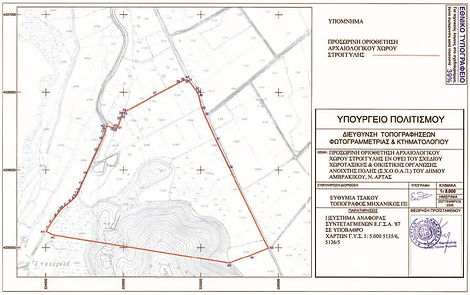
The first administrative measures concerning the protection of antiquities at Strongyli date to Ministerial Decision 15794/19.12.1961, published in Government Gazette 35/B/02.02.1962. This decision placed the site under archaeological protection and declared the remains of a building complex, initially identified as of Byzantine origin, to be historically preserved monuments. The competent authority was designated as the local 8th Ephorate of Byzantine Antiquities. However, based on current scholarly research, no Byzantine structures have been identified at the site. The initial administrative act likely resulted from a misdating of the octagonal building (the bath complex), which later archaeological investigation confirmed as Roman rather than Early Christian. Approximately one year later, Ministerial Decision 15904/24.11.1962 (Government Gazette 473/B/17.12.1962) recorded the remains of the Roman-period building complex and bath structures, including the preserved mosaics within the Strongyli Community, as archaeological sites. The management and protection of this cultural heritage were assigned to the 12th Ephorate of Prehistoric and Classical Antiquities. It should be noted that both of these measures established a framework of partial protection, as they were not accompanied by topographical documentation accurately defining the extent, precise boundaries, or spatial parameters of the monuments. The full and definitive delimitation of the archaeological site, with legal authority and precise definition of the protected zone, was only achieved much later. The relevant decision was enacted through publication in Government Gazette 111/AAP/27.05.2011 [YPPO/ GDAPC/ARCH/A1/F33/41288/1825/19-04-2011]. For the first time, this decision introduced an official topographical plan and defined the scope of the protected area, ensuring the necessary safeguarding of the significant antiquities preserved in the region. This included both Podarouli Hill, which contains the main core of the site, and the underlying and surrounding lowland areas.
In 1946, Fotios Petsas, serving as Ephor of the 10th Archaeological District (Epirus), conducted a site inspection at Strongyli following a report from the schoolteacher G.D. Gazetas. During the inspection, he identified Classical-period architectural remains within a marsh, as well as an octagonal building, which, according to the archival records of the relevant archaeological service at the time, was erroneously classified as Byzantine. A turning point in the study of Strongyli was the interpretation by Professor S. Dakaris, who argued that the preserved antiquities constituted an extensive Roman complex, reflecting the broader economic and social development of Epirus during the Roman period. The ruins on Podarouli Hill were identified as a rural-type villa (villa rustica), while the octagonal building was interpreted as a bath complex integrated into the broader villa estate. Dakaris initially dated the complex to the 1st century BCE; subsequent archaeological research revised this to the 1st–4th centuries CE.
The first systematic archaeological fieldwork began in 1989 under the 8th Ephorate of Byzantine Antiquities of Ioannina. At the foot of Podarouli Hill, at the northern end of Mavrovouni, installations related to olive production and a bath complex from the Roman period were identified, while on the hilltop remains of mosaic floors and looted box-shaped tombs were documented. In 1992 and 1994, Boston University, in collaboration with the 12th Ephorate of Prehistoric and Classical Antiquities and the 8th Ephorate of Byzantine Antiquities, conducted the most comprehensive surface survey to date as part of the interdisciplinary Nikopolis Project. This investigation included archaeological and geoarchaeological study of the hills and surrounding area, yielding new insights into the region’s geological evolution. In the same year, at the site of Arapospita, a building constructed with rectangular and polygonal stones was discovered. The morphology of the masonry, combined with fragments of fine black-gloss pottery recovered from nearby fields and donated by a local resident, dated the building to the late Classical and early Hellenistic periods (3rd–4th centuries BCE). Systematic mapping further allowed identification of additional monumental units along the hill ridge: in the southwestern slopes of Podarouli Hill, remains of an olive press were recorded; in the southeastern area, a large vaulted building interpreted as a therapeutic bath complex was documented; and at the hilltop, structural elements of a Roman-period villa rustica with mosaic floors were revealed. Slightly eastward, two box-shaped tombs, likely associated with the villa’s burial context, were identified.
As part of the 1992 operations, the 12th Ephorate of Prehistoric and Classical Antiquities commissioned a conservation team under A. Chiotis to clean and provide initial protection for the mosaic floors on the hilltop (Rooms 12 and 13), which were subsequently covered with a temporary protective structure. Their documentation highlighted their high artistic value and the need for systematic future conservation. During 1993–1994, under the supervision of the 12th Ephorate and with funding from the Strongyli Community through the LEADER I program, excavations revealed most of the villa rustica and additional mosaic floors (Rooms 7 and 10). After their exposure, the floors were temporarily covered with provisional protective structures. Topographical mapping from the same period produced a comprehensive plan of the site. Architectural evidence indicates that the villa comprised two wings: the southern wing contained the main residential units (nine rooms arranged in a U-shape around the elongated entrance hall, Room 8, which also formed the principal entrance), while the northern wing contained four additional spaces, with Room 4 likely corresponding to a courtyard. The building follows the corridor/porticus villa type. Use of the complex is documented from the 1st to the 3rd centuries CE, with repeated modifications to the original plan. Portable finds include unpainted domestic pottery, relief lamps, cups, amphora fragments, a few architectural elements, and a limited number of coins from the periods of Augustus, Septimius Severus, Caracalla, and Gallienus.
In 1994, limited excavations at the octagonal building on the southwestern slopes of Podarouli Hill were undertaken, confined to removal of deposits and exposure of portions of the masonry. Finally, in 2001 and 2002, the 12th Ephorate conducted excavations and structural works at the olive press. Deposits were removed down to bedrock, exposing the external walls of the workshop, three stone presses with internal niches and a central stone pillar, and three stone basins of the press. The presses were temporarily relocated to a nearby field for conservation and reassembly, and later reinstalled on artificial bases. The remaining area was uniformly backfilled with gravel for protection.
Beginning in 2024, and systematically from 2025, an Excavation Program has been implemented under a collaboration protocol between the Arta Ephorate of Antiquities/Ministry of Culture and the University of Patras (Department of History and Archaeology). Following issuance of a permit to the University of Patras for a five-year program (2025–2029), systematic archaeological research of the Strongyli site in Arta is being conducted in collaboration with the Arta Ephorate of Antiquities [ADA: 90ΨΕ46ΝΚΟΤ-7ΦΑ /04.08.2025]. The program includes both excavation and surface survey under the direction of Theodora Kontogianni, Head of the Department of Prehistoric and Classical Antiquities and Museums, acting as deputy head of the Arta Ephorate, with participation of the University of Patras research team, led by Professor Christos Merantzas (History and Archaeology of Civilizations, Department of History and Archaeology) and a team of students from the department.[1]
[1] Excavation Team Participation
During the September 2024 excavation season (01.09–14.09), the following students participated: Olga Karypi, Anthia-Iliana Kotsori, Maria-Athena Markou, Dimitrios Dtzimas, Manolios Papadomanolakis, Maria Prombona, and Maria Spyropoulou. During the August–September 2025 excavation season (28.08–13.09), the following students participated: Anastasios Exarchopoulos, Dionysios Kaproulias, Panagiota Kontaxi, Paraskevi Koutroumani, Ioannis Leontiou, Stavros Barbas, Epameinondas Xanthos, Sotirios Papageorgiou, Konstantinos Papanagiotou, Panagiotis-Pythagoras Paralaimos, Maria Prombona, Eirini Sioli, and Dimitrios Stravoskoufis.